Quick Answer
A Belize forex license is issued by the Financial Services Commission (FSC) Belize, formerly known as the International Financial Services Commission (IFSC) under the Securities and International Financial Services Act. Applicants need a Belize company, local directors, a registered agent, an AML/CFT compliance framework, and proof of minimum capital that can range from roughly BZD 50,600 up to BZD 1,000,000 depending on the specific license category. Approval timelines typically run from a few months up to six months, and government fees are modest compared to onshore markets, though legal and compliance preparation usually forms the bulk of the real cost.
If you're researching a forex license, you've probably already come across Belize in almost every offshore forex licensing comparison out there, and there's a reason this small Central American jurisdiction keeps showing up. It combines a straightforward regulatory process with a tax structure that international brokers find genuinely workable, without the multi-year approval cycles seen in more heavily regulated onshore markets.
At Neptune Fiduciaries Group, I've worked with founders weighing Belize against jurisdictions like BVI, Vanuatu, and St. Lucia, and the hesitation is rarely about whether Belize is a legitimate option. It usually comes down to not knowing exactly what the license requires, how much capital actually needs to sit in the bank, and what the true cost looks like once legal and compliance work is added on top of government fees.
This guide walks through all of it: what the license covers, why founders choose Belize specifically, the real step-by-step process, realistic timelines, a full cost breakdown, and the mistakes that most commonly delay approval.
Start Your Global Business
Journey Today
Whether you're launching a new venture or expanding globally, our experienced advisors provide tailored corporate and banking solutions designed for long-term success.
What Is a Belize Forex License?
A Belize forex license is the regulatory authorization that allows a company to legally offer forex trading, brokerage, or dealing services in or from Belize. Without it, a company cannot lawfully operate as a forex broker or dealer under Belizean law, regardless of where its clients are located. The license is issued by the Financial Services Commission (FSC) Belize, the same regulator most of the market still refers to by its older name, the International Financial Services Commission, or IFSC.
The FSC operates under the Securities and International Financial Services Act (SIFSA), which sets out the licensing structure, corporate governance expectations, and risk management standards that forex businesses in Belize must meet. This framework also brings in related legislation, including the Economic Substance Act, the Money Laundering and Terrorism (Prevention) Act, and the Accounting Records (Maintenance) Act, all of which shape what a licensed company must maintain on an ongoing basis, since companies holding this license must prove their core income-generating activities actually take place within Belize.
What makes Belize distinct from some newer offshore centers is the length of time this framework has been in place. The IFSC was established in 1999 specifically to regulate international financial services activity, which means Belize has decades of licensing history and a regulator that banks and payment processors are already familiar with. Understanding that the Belize forex license sits inside this established structure, rather than being an informal offshore stamp, is exactly why so many founders take it seriously when comparing jurisdictions.
If you're comparing Belize against other offshore options, it's also worth reviewing our guide to offshore company formation jurisdictions to understand how the right base entity structure affects your licensing path.
Why Some Founders Choose Belize Over Other Jurisdictions

Cost accessibility is usually the first thing that draws founders toward a Belize forex license. Compared to onshore regulators or even some other offshore jurisdictions, Belize's government fees and capital thresholds sit on the lower end, which makes it a realistic entry point for brokers who aren't yet operating at institutional scale. This doesn't mean the process is unsupervised; it means the barrier to entry is calibrated differently.
Belize's tax structure adds to the appeal. The jurisdiction applies territorial taxation, meaning income generated outside Belize is generally not subject to local corporate tax, which is particularly attractive for brokers serving an international client base rather than domestic Belizean customers. This pairs naturally with the country's common law legal system, based on English law, which gives founders and their banking partners a familiar, predictable legal foundation to work from.
The regulatory balance is what founders consistently mention when comparing Belize to jurisdictions like BVI or Vanuatu. It's rigorous enough to require a genuine compliance program, proper AML/CFT procedures, and ongoing reporting, but without the extended multi-year approval timelines or extremely high capital thresholds seen in Tier-1 markets. That balance of affordability, tax efficiency, and workable compliance expectations is exactly why Belize remains a recurring choice, though actually securing the license still depends on following the right process from day one.
Licensing is just one piece of the puzzle for the full picture of what launching a brokerage actually costs; check out How Much Does It Cost to Start a Forex Brokerage?
Step-by-Step Process to Get a Belize Forex License
Getting licensed follows a defined sequence, and knowing each stage in advance helps avoid the back-and-forth that slows down first-time applicants.
- Incorporate a Belize company: Form the underlying entity with the required share capital structure, appoint the minimum number of directors and shareholders, and set up a registered agent and office in Belize before any regulatory filing can begin.
- Prepare core documentation: Draft the Memorandum and Articles of Association, a detailed business plan covering your trading model, and a full AML/CFT compliance manual that the FSC will review closely during the application stage.
- Deposit and verify capital: Open a local bank account, deposit the required minimum capital based on your license category, and obtain formal bank confirmation showing the funds are held and available as required.
- Submit the application to the FSC: File all corporate documents, the operating manual, due diligence records, and proof of capital with the FSC (formerly IFSC), making sure every document matches what the regulator expects to see.
- Respond to queries and receive approval: Address any clarification requests promptly during review, since responsiveness directly affects approval speed, and once licensed, ongoing compliance and reporting obligations begin immediately.
Having documentation genuinely ready before submission, rather than assembling it reactively after the FSC asks questions, is what separates a smooth approval from months of unnecessary delay, which naturally raises the question of how long the entire process realistically takes.
Curious how Belize stacks up against another popular low-cost option? Here's a full breakdown of the Seychelles route: Seychelles Forex Brokerage License: Start Your Offshore Journey.
How Long Does It Take to Get a Belize Forex License?
Timelines depend heavily on how prepared the application is at the point of submission, but there's a fairly consistent pattern across most cases.
- Company incorporation: This is typically the fastest stage, taking anywhere from a few days to about two weeks once the corporate structure, directors, and registered agent details are finalized and ready to file.
- Documentation and compliance manual preparation: This stage often takes several weeks, since building a genuinely detailed business plan and a functioning AML/CFT program takes real time, especially for founders new to the process.
- Bank account opening and capital deposit: Depending on the bank's own due diligence process, this stage can take anywhere from two to six weeks, and delays here often affect the overall submission timeline.
- FSC review period: Once submitted, the regulator's review typically takes two to four months, though this can extend further if the FSC requests additional clarification or documentation mid-review.
- Total realistic timeline: Most well-prepared applications move from company formation to final approval within roughly three to six months, while incomplete or poorly structured submissions can take considerably longer.
Applications that arrive with an incomplete AML manual or unclear ownership structure tend to stretch well beyond this range, since every regulator query effectively resets the clock on that portion of the review. Knowing this timeline upfront helps set realistic expectations, and it feeds directly into planning the actual costs involved.
If you're weighing costs across jurisdictions before deciding, it's worth seeing how Vanuatu's numbers compare: Vanuatu Forex License Cost.
Cost of a Belize Forex License: Full Breakdown
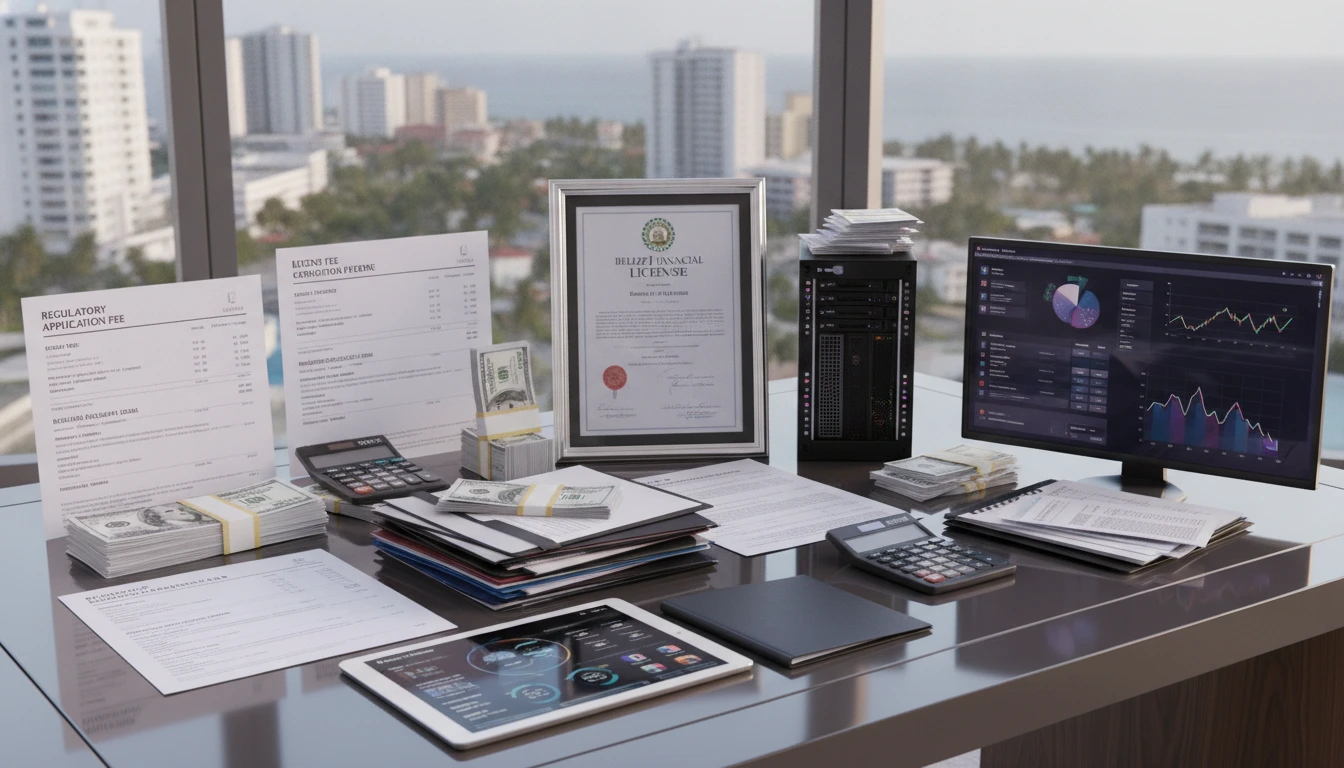
Understanding the true cost of a Belize forex license means looking past the headline government fee to everything required to get licensed and stay compliant afterward.
| Cost Item |
Typical Range |
| Company incorporation |
BZD 3,000 to 7,000 (includes government and agent fees) |
| FSC application fee |
Approximately BZD 1,000, payable at the time of application |
| Minimum capital requirement |
From roughly BZD 50,600 up to BZD 500,000, depending on license category and scope |
| Annual license fee |
From approximately BZD 10,000 upward, depending on license type |
| Registered agent and office (mandatory) |
BZD 3,000 to 6,000 per year |
| AML/CFT compliance manual and legal support |
BZD 20,000 to 50,000+ depending on complexity |
| Bank account opening and compliance |
BZD 4,000 to 10,000 in professional support fees |
The government fees themselves are relatively modest; the real cost variable is almost always the compliance documentation and legal structuring work, since a thin AML manual or poorly prepared business plan submitted cheaply often ends up costing more in delays and resubmissions than proper preparation would have upfront. If capital deposit and banking are part of your plan, our bank account opening services page walks through how that process typically works alongside licensing.
Common Mistakes That Delay a Belize Forex License Application
Even well-capitalized, serious applicants run into avoidable delays, and it's usually for the same handful of reasons.
- Submitting a vague or generic business plan: The FSC expects real detail on the trading model, client onboarding process, and risk controls, so a generic or copy-pasted plan almost always triggers follow-up requests that extend the review.
- Treating the AML/CFT manual as a formality: A functioning compliance program needs to be genuinely built and documented before submission, not drafted quickly at the last minute just to check a box on the application checklist.
- Underestimating capital deposit timelines: Bank verification of deposited capital can take several weeks on its own, and founders who start this step too late often end up delaying the entire filing unnecessarily.
- Appointing directors without relevant experience: The FSC reviews the background and qualifications of management closely, and directors without a genuine financial services history can raise questions that slow the review considerably.
- Slow responses to FSC information requests: Since review timelines depend partly on applicant responsiveness, delayed replies to regulator queries directly extend how long the entire licensing process ends up taking.
Most of these issues are entirely avoidable with proper preparation and experienced guidance from the outset, rather than treating the application as a paperwork exercise that can be assembled at the last minute.
Why Choose Neptune Fiduciaries Group for Belize Forex Licensing
Understanding the Belize regulatory framework on paper is one thing; actually preparing a compliant business plan, AML manual, and documentation package that satisfies the FSC's expectations is where most applications either move smoothly or stall for months. This is exactly where Neptune Fiduciaries Group comes in, helping structure the entity, capital deposit process, and compliance groundwork the FSC expects to see from the first submission.
Working daily across offshore company formation, registered agent services, and trust and foundation registration means seeing the same recurring gaps in forex license applications: thin AML documentation, capital deposited without proper bank verification, and director appointments that don't reflect the financial services background regulators look for. Every one of these is avoidable when the structure is handled correctly from the start.
Whether you're building a new forex brokerage from scratch or restructuring an existing offshore entity to meet Belize forex license requirements, having a partner who understands both the FSC's expectations and the practical realities of Belizean company formation makes the entire timeline far more predictable and considerably less stressful to manage on your own.
Start Your Global Business
Journey Today
Whether you're launching a new venture or expanding globally, our experienced advisors provide tailored corporate and banking solutions designed for long-term success.
Conclusion
A Belize forex license offers a genuinely workable combination of affordability, territorial tax efficiency, and a realistic regulatory bar compared to many other offshore and onshore jurisdictions, but reaching approval still requires real preparation rather than a quickly filled-out form. The FSC's review process rewards applicants who arrive with a properly structured company, verified capital, and a functioning AML/CFT program already in place.
For founders serious about building a credible, properly licensed forex brokerage, the time invested in getting the structure right upfront consistently pays off in fewer regulator queries, faster approval, and a stronger compliance foundation to operate on long-term.
FAQs
What is the minimum capital requirement for a Belize forex license?
Capital requirements vary by license category, ranging from roughly BZD 50,600 for lower-tier licenses up to BZD 1,000,000 for full dealer-level licenses, so confirming the exact threshold for your intended business model with the FSC or a licensing advisor is essential before applying.
Is Belize a good jurisdiction for forex brokers compared to BVI or Vanuatu?
Yes, for many founders, Belize generally offers lower capital thresholds and faster setup than BVI, while still operating under an established regulator with decades of licensing history, making it a strong middle-ground option depending on your budget and target market. If BVI is still on your radar, this breakdown covers what that route looks like: BVI Forex Broker License.
How long is a Belize forex license valid before it needs renewal?
Belize forex licenses are typically issued for one year, with renewal requiring proof of ongoing regulatory compliance, updated documentation, and payment of the annual license fee to the FSC.