Quick Answer: International company establishment involves choosing the right jurisdiction, incorporating the business legally, opening international bank accounts, and ensuring ongoing legal and tax compliance in each country of operation.
Have you ever wondered what is an international company? In simple terms, it is a company that has outlets in more than one nation. These businesses are also known as multinational businesses, and such businesses conduct business at a global level, deal with customers around the globe, and link markets internationally.
Foreign regulations, cultural differences, and logistics are problems faced by international company definition in a unique way, yet there are massive opportunities available to these companies. The multinational corporations numbering more than 80,000 all around the world indicate how significant cross-border business has turned out to be, according to UNCTAD.
Nowadays, even small companies can also become global and enter new markets and international development. The first step towards globalisation is to know how an international company formation, whether it is in selecting the appropriate location to operate in or whether it is in international law.
Also Explore:
Complete Guide to Startup Company Formation for Entrepreneurs
Start Your Global Business
Journey Today
Whether you're launching a new venture or expanding globally, our experienced advisors provide tailored corporate and banking solutions designed for long-term success.
What is an International Company?
.webp)
What is an international company, then? It can be simply explained as a business that is based in more than one country. It is also known as a multinational business and is involved in international business operations, international marketing of products or services, and where it has teams or offices in other countries. A local company simply sells the goods, but an international company is very cautious about the way it operates in the rest of the world.
This may involve the employment of different employees, localising products to meet local demands, or establishing subsidiaries in other countries. Concisely, it is a company that is operating within more than one time zone and under various sets of rules simultaneously. A good instance of cross-border business is the fact that even small businesses in the contemporary world can go international either through e-commerce or, more so, through partnerships.
Investigations reveal that firms that have international business ability can expand much quicker by 30-50 per cent than businesses that remain local. The key to thinking globally is to know what an international company would be. It is also beneficial in case of international business establishment or offshore company formation, and it is easier to access new markets and grow the business without fear.
Benefits of Forming an International Company
There are a lot of benefits to expanding your business outside of your home country. A multinational business can access new markets, maximise its profit, and solidify its international base. Internationalisation is not merely selling to foreigners, but it is establishing opportunities that local companies might never obtain.
The advantages are some of the following:
- Inclusion in markets worldwide: By expanding and selling products or services overseas, your business is able to tap a larger market and have diversified sources of revenue. This is the primary reason why companies consider cross-border business opportunities.
- Economy and resource optimisation: Establishing a business in other countries can save money in production, harness domestic talent, and enhance distribution channels.
- Increased brand awareness on a global level: International presence generates credibility among customers, gains more partnerships, and makes your company a serious participant in the international operations system.
- Foreign investment opportunities: There are more chances that investors will invest in a business that has a global presence. Venture capitalists and banks usually have an interest in international business set up by international companies.
- Risk diversification: By being in more than one country, your company will not suffer during economic downturns or other local market problems, as your business is more robust.
Furthermore, by establishing an international business, you will have an opportunity to consider offshore company formation, which might offer you an opportunity to enjoy tax benefits, regulatory benefits, and find it easier to access international banking. These advantages indicate why global expansion has been a top priority for both small and big businesses, including startups and large companies.
How to Set Up an International Company (Global/International Company Establishment)
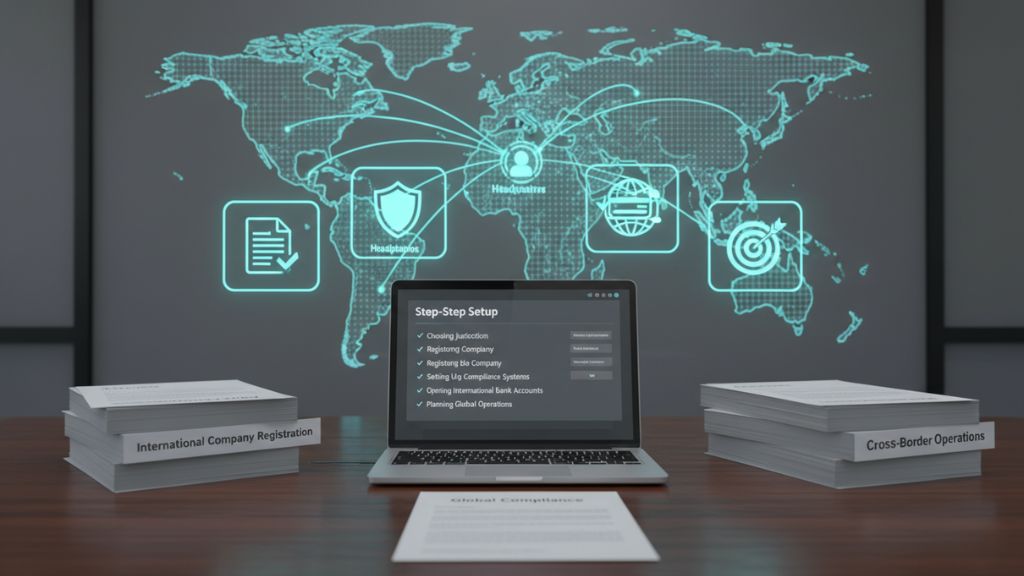
After realising the advantages of going global, the other thing is knowing how to establish an international company. Sometimes it may not be easy to establish a business across borders, but with proper planning and direction, it will be feasible. A global company needs strong attention to legal, financial, and operational factors to facilitate business processes driven by the global market.
Here is a roadmap that can be used to begin:
- Select the appropriate jurisdiction: The choice of tax benefits, legal structure, and ease of doing business are some of the factors that are considered when selecting a country to be registered. Offshore company formation is another area that is pursued by many entrepreneurs in order to maximise cost savings and compliance.
- Incorporate your business: Finalise all the required processes to make your business legal in a foreign country. This involves registration of incorporation documents, appointment of directors, and business licenses for an international business establishment.
- Open international bank accounts: It is important to have online bank accounts in other countries to facilitate easy transactions, pay local workers, and also ensure that they make payments across international borders effectively.
- Legal and tax compliance: International firms should comply with local laws, tax laws, and reporting. To make this step less complicated, it is possible to hire the services of professional advisors and minimise risk.
With proper guidance, the establishment of an international company is no longer a threat. Contacting such professional services as Neptune Fiduciaries Group could assist in simplifying the process of corporate registration, offshore company formation, and banking formation, so that you can concentrate on expanding your business worldwide without violating the rules and compromising its integrity.
International vs. Multinational vs. Global Company: What's the Difference?
These three terms are often used interchangeably in everyday business language, but each carries a slightly different meaning depending on how a company structures its operations across borders. Here's how they compare:
- International company: Operates in more than one country, often adapting its products, pricing, or operations to fit each local market it enters.
- Multinational company (MNC): Has significant operations, staff, or subsidiaries in multiple countries, usually with more localized decision-making given to each regional office.
- Global company: Runs on a unified strategy and brand across all markets, treating the world as one integrated market rather than a set of separate local ones.
- International corporation: Functionally the same as an international company; "corporation" and "company" are used interchangeably in this context, with the distinction depending more on legal structure (incorporation type) than on how the business actually operates internationally.
- Foreign company: A narrower, more specific term referring to a company incorporated in one country but registered or operating within another, often used in a legal or regulatory context rather than as a general business descriptor.
In practice, these terms overlap significantly, and most businesses don't fit neatly into just one category; a single company might describe itself as "international," "multinational," or "global" depending on the audience and context.
Common Challenges International Companies Face
Although a company can get numerous opportunities when it goes global, there are certain challenges to running an international company. To carry out its activities efficiently, a multinational business has to navigate laws, cultures, and markets. These challenges should be understood to establish a successful cross-border business.
- Cultural and language hindrances: Doing business in other nations entails accommodating the local practices, language, and business etiquette. Miscommunication may have an impact on team operations, relationships with clients, and the entire global operation.
- Complicated legal and tax compliance: There are legal and tax laws in every country. It can be complex to ensure that your international firm operates according to all the local needs, such as reporting and corporate governance.
- Currency fluctuations and financial risks: International business corporations tend to work with various currencies. The exchange rate may experience sudden fluctuations that affect profits, prices, and cash flow; proper financial planning is important.
- Logistics and supply chain management: Movement of products across borders entails the issue of customs, duties, and transportation. There must be efficient planning of the products so that they reach the international customers on time.
Irrespective of these hurdles, several businesses have been able to grow through planning, expert advice, and using services that one can rely on. With the advice of corporate registration, banking, and compliance providers such as Neptune Fiduciaries Group, international expansion is no longer a risky and hard-to-manage process, and your multinational business is able to flourish all over the world.
Also Explore:
What Is an IBC? A Simple Guide for Global Businesses
Why Choose Neptune Fiduciaries Group for International Business Services
Global expansion may not be an easy task, yet Neptune Fiduciaries Group simplifies it. They also assist companies in international business establishment, offshore company formation, Bank Account Opening, and international business management, which makes international operations smooth.
Neptune Fiduciaries Group helps save time and minimise risks, as you are under the guidance of an expert on corporate registration, banking, and compliance. Their team will take care of all your legal and financial needs when expanding across borders, making international expansion easier.
Neptune Fiduciaries Group offers reliable global expansion solutions, whether you are beginning a small business or expanding an already established company. Through them, it is easy to establish a global firm without any complications.
Start Your Global Business
Journey Today
Whether you're launching a new venture or expanding globally, our experienced advisors provide tailored corporate and banking solutions designed for long-term success.
Conclusion
Understanding what is an international company is the first step toward taking your business global. Going global is an enormous opportunity, not only in terms of accessing a new market, but also in improving the brand image and drawing global investment. The problems, such as cultural differences, legal compliance, and currency changes, are present, but with proper planning and professional help, one can go through them without any issues.
Neptune Fiduciaries Group facilitates the establishment and management of multinational businesses efficiently with its services such as offshore company formation, corporate registration, and international banking services. It is possible to grow by identifying reputable partners and navigating the complexity of cross-border business without worrying about it.
FAQs
Is a global company the same as an international company?
Not exactly. A global company operates with a unified strategy and brand across all markets, treating the world as one integrated market. An international company typically adapts its products, pricing, or operations to fit each local market it enters. In practice, the terms are often used interchangeably.
What's the difference between an international company and a multinational company (MNC)?
An international company operates in more than one country, often adapting to local markets. A multinational company (MNC) usually has significant operations, staff, or subsidiaries in multiple countries with more localized decision-making in each region. The two terms overlap heavily in everyday use.
Is "international corporation" the same as "international company"?
Yes, "international corporation" and "international company" are used interchangeably in everyday business language, both referring to a business operating in more than one country.
What are some examples of international companies?
Well-known examples include Coca-Cola, Toyota, and Unilever, each operating in dozens of countries while adapting products or operations to local markets. Even a small e-commerce business selling to customers in multiple countries technically qualifies as an international company.