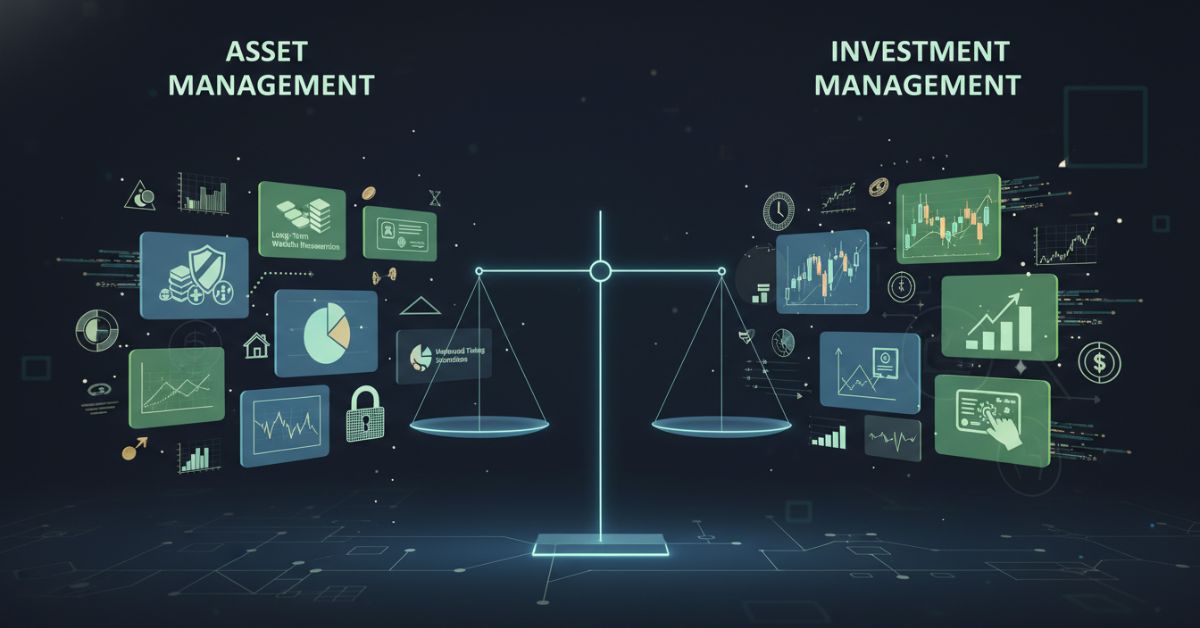
The issue that many people are confused when they listen to asset management vs investment management, since they are similar but not equal. The two simply are financial planning and wealth management, albeit in different modes, serving businesses and investors differently.
When comparing asset management and investment management, it can be seen that the former is largely about how to safeguard and organize what is already in hand, i.e., property, cash, equipment, and business resources. It assists in maintaining everything safe and in good order. Investment management, however, concentrates on expanding money via portfolio management, investment strategies, and selecting the appropriate financial prospects to boost the returns.
As is the case in global business today, particularly in offshore companies and other international set-ups, it is of utmost importance to understand the difference between asset management and investment management. Both collaborate to achieve financial security, risk management, and long-term prosperity in the face of businesses in the modern world.
What are Asset Management and Investment Management?
To get a clear picture of asset management vs investment management, we should have an idea of their basic meaning. Asset management involves managing and preserving available resources of a business, such as cash, property, equipment, and other financial resources of a business. It is concerned with safety, orderliness, and the correct utilization of assets via asset monitoring and corporate asset administration.
Investment management aims at increasing money using sensible financial choices. It features share dealings, portfolio management, stocks, and other investments with better returns. This is intimately associated with wealth management, portfolio management, and investment strategies to grow capital over time.
Simply put, asset management vs investment management uses two distinct target objectives- first, you do not lose what you have, and secondly, you make your money increase. They both are essential in the context of businesses today, particularly in international and offshore corporations, where finances are the most important factor.
Also Explore:
Boost Efficiency with the Best Digital Asset Management
Why Asset Management Is Important for Modern Businesses

Asset management has a very significant role in the business environment, which we know about asset management vs investment management. It assists the firms in managing their resources such as cash, property, equipment, and other digital properties. Through asset tracking systems and appropriate management of their corporate assets, companies are able to save on losses and allocate their assets more effectively.
Efficiency and unnecessary costs will also be enhanced because of good asset management. Financial planning and asset optimization strategies can help companies make better decisions. It is quite handy for offshore companies and world businesses where assets are distributed in various locations and require quality control.
To put it in plain terms, asset management vs investment management demonstrates that the former is interested in protection and control. It assists companies to remain afloat, control risks, and establish a good pillar towards long-term prosperity in the current competitive market.
Also Explore:
Offshore Company with a Bank Account: A Clear Guide by Neptune
The Difference Between Asset Management and Investment Management
It is worthwhile to get a feel of the nature of the relationship between asset management and investment management in business scenarios before proceeding to the details. They are both related to financial planning and wealth management, though they apply to different causes in a modern company, particularly an offshore and global business structure.
- Specialty: The specialty of asset management deals with the management and protection of pre-existing business resources such as property, equipment, cash, and data. Investment management aims to increase money by investing in stocks, bonds, and mutual funds, among other financial products, by utilizing portfolio management.
- Main Goal: Asset management is geared towards ensuring the value preservation, increased efficiency, and minimized waste using the appropriate asset tracking and corporate asset management systems. Investment management is about multiplying wealth through intelligent investment strategies and financial market analysis that would yield higher returns in the long term.
- Risk Level: This is a low-risk asset management since it cushions and manages what is already there. Investment management is riskier since it is subject to the performance of a market; it is also better in terms of ROI and growth of the capital.
- Resources and Technique: Asset management incorporates tools such as the asset lifecycle tool, financial planning tools, and resource optimization tools. The investment management employs instruments such as portfolio diversification, fund analysis, risk assessment models, and market forecasting methods.
- Business Utility: Asset management helps in day-to-day activities and stability over time by making sure that the resources are utilized appropriately. Investment management fosters growth and wealth creation, which assists businesses in increasing their financial base and venturing into new markets in the global market.
In the case of asset management vs investment management, both have varying but related roles in the success of a business. The first one is a safeguard of what a company already possesses, and the latter is an expansion of it, done with clever financial choices. The ability to combine the two will enable businesses to have greater financial control and improved long-term outcomes.
Also Explore:
Assets and Investment Management: Grow Wealth Smartly
Future of Asset Management vs Investment Management in Global Markets
Asset management vs investment management is a debate whose significance in global markets is likely to be increasingly important in the near future concerning the future of finance. Companies are going international, digital systems, offshore systems, and sophisticated financial management are being used to manage their assets, as well as investing funds in a much more intelligent manner. And this movement is turning the financial systems more interconnected, efficient, and data-driven.
- Digital Transformation & Automation: The asset management is shifting to AI-based asset tracking, smart monitoring systems, and automated reporting tools. Algorithms and robotised advisors are also becoming more popular in investment management as people are transferring to faster and more precise decisions based on algorithms and artificial intelligence in the management of their portfolios.
- Worldwide Wealth Diversification: Firms are diversifying not only investments but also assets among different nations to diminish risk. This aids in insulating wealth against market instabilities in the domestic market and also increases financial security in the long term in global economies.
- Data-Driven Financial Decisions: In both areas, big data, predictive analytics, and financial modeling have all been very significant in use. The tools can be used by businesses to learn more about the market trends, enhance investment approaches, and use resources more profitably.
- Developed Risk Management Systems: With increased uncertainty in the world, corporations are paying attention to enhanced risk management. Asset management helps in the risk protection of the resources, whereas investment management is involved in balancing the investment risks and returns by the use of a diversified portfolio and long-term planning.
- ie-in with Global Financial Ecosystems: Investment management and asset management no longer stand alone. They are also joining wealth management, corporate structuring, and offshore financial services to form a more integrated and effective financial ecosystem.
In comparing asset management and investment management, the future is characterized by reduced dependence on investment management and increased reliance on integrating technology. There is increasing intelligence and automation in asset management and predictive and strategy-driven investment management. This mix enables businesses to make quicker and smarter financial decisions.
Also Explore:
Domestic vs Offshore Asset Protection Trusts: Which Is Best?
Which One Do Businesses Actually Need?

Trying to compare asset management and investment management, businesses frequently believe that they have to choose either, yet it is not the case. Protection and organization of the available resources, such as cash, property, equipment, and business assets, should be done with asset management. It assists in financial planning, asset tracking, and maintains daily operations to be stable and controlled.
Investment management, on the other hand, is needed for growth. It works on portfolio management, investing styles, and growing wealth by making intelligent financial choices. It assists companies to receive a higher payoff and widen at the global market, particularly in offshore and global frameworks.
Put simply, asset management and investment management demonstrate that both are the same in terms of importance. The management of assets brings about safety and stability, and investment management brings in growth and profit. In order to be safe and competitive in the modern financial environment, businesses must have a balance of both.
Also Explore:
Which Investment Has the Least Liquidity? Explained
How Neptune Fiduciaries Corporate Helps in Business Structuring & Wealth Protection
Businesses must also have good structuring and protection systems when dealing with the issue of asset management vs investment management. Neptune Fiduciaries Corporate assists businesses with the establishment of appropriate business forms that facilitate financial planning, asset security, and long-term stability through the design of offshore company formation, along with a registered agent.
It also assists in wealth protection since it assists in trusts, foundations, and the opening of international bank accounts. These services enhance the management of assets of the corporation, diminish the financial risks, and facilitate the existence of efficient global operations in the various jurisdictions.
In layman's terms, the distinction between asset management vs investment management is the way the money is used to grow and spread, but in Neptune Fiduciaries Corporate, there is a necessity to make sure that the framework behind it is safe. This assists the companies to remain in line, orderly, and safe in international markets.
Conclusion
Knowledge of asset management as opposed to investment management is quite essential to any contemporary business intending to remain viable and develop in the international market. Asset management is beneficial in the preservation and structuring of the already available resources, such as cash, properties, and business assets, whereas investment management is aimed at generating wealth via prudent asset management and investment decisions.
The modern competitive world cannot leave companies based on a single technique. A good, balanced decision on asset management vs investment management has a way of assuring improved financial planning, risk management, and long-term success. When the two combine, the businesses will be able to shield their riches, as well as multiply them in an organized manner.
By structuring their business properly, offshore solutions and wealth protection services such as those provided by Neptune Fiduciaries Corporate, companies can be able to better control their safety and growth. Ultimately, the combination of two systems in an intelligent and proportioned manner leads to success.